 author
Deciding on outdoor freestanding digital signage versus wall mounted digital signage strictly involves location logistics, rather than aesthetics. Track pedestrian flow. Check for a structurally sound wall. Assess direct sun exposure. Moreover, consider maintenance access. Ultimately, proper outdoor digital signage must integrate seamlessly. It cannot introduce fresh mounting complications.

The key difference is where the structure carries the screen. Freestanding digital signage uses its own cabinet and base, while a wall mounted display depends on a wall, column, or building surface. That affects visibility, installation, maintenance, and interaction.
| Factor | Outdoor Freestanding Digital Signage | Wall Mounted Digital Signage |
| Placement | Independent ground position | Fixed to a suitable structure |
| Floor space | Needs a footprint | Keeps the floor clear |
| Viewing position | Can follow pedestrian flow | Depends on wall location |
| Touch use | Easy to place at user height | Height may limit interaction |
| Maintenance | Usually accessible at ground level | High mounting can complicate service |
| Outdoor structure | Needs secure anchoring and cabinet protection | Needs reliable wall fixing and weather protection |
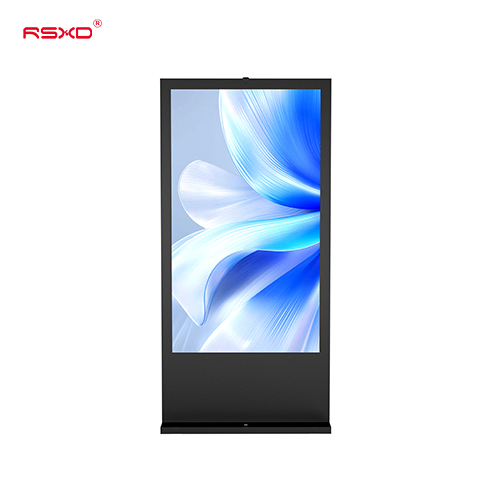
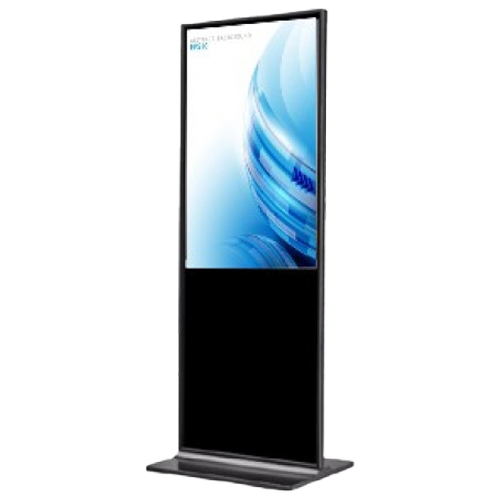
Floor standing digital signage places the display inside a vertical cabinet that stands independently. Outdoors, that cabinet also has to handle rain, dust, heat, sunlight, and physical access. An outdoor digital signage kiosk is not simply an indoor screen on a stand.
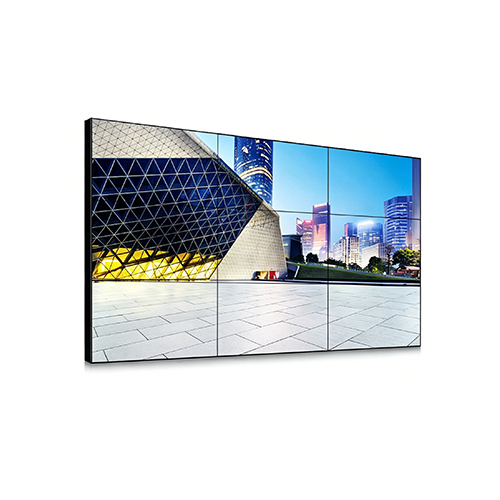
Wall mounted digital signage fixes the screen to a building surface. It suits narrow passages, covered entrances, and fixed information points. If the wall is already in the right sightline, this can be the cleaner choice.
Choose this format when the site makes wall installation awkward or the display needs to meet people where they actually move. The strongest reasons are practical, and they usually become obvious during a site survey.
Plazas, pedestrian streets, park entrances, transport areas, and open forecourts often lack a useful mounting surface. An outdoor freestanding display can sit closer to the traffic path. It still needs a stable base and safe anchoring, but outdoor digital signage installation is no longer tied to building geometry.
A wall may exist but be too far from passing visitors. Moving an outdoor digital advertising display closer to an entrance can improve viewing angles. In strong daylight, a high brightness outdoor display and sunlight readable digital signage setup also matter. Brightness should match real sunlight exposure, not just a catalog number.
A freestanding digital kiosk can place the screen at a practical interaction height. That works for maps, inquiries, product browsing, QR actions, and interactive outdoor digital signage. Some outdoor configurations also support touch, so the screen can do more than play advertising.
Filters, seals, cooling parts, and power modules eventually need attention. Ground-level access can make service easier. Outdoor product documentation also describes replaceable dust filters and sealing components, while remote management can monitor device status, push content, and support fault checks without a site visit for every small issue.
Freestanding is not always better. If pedestrian space is tight or the display will stay in one position for years, a wall installation may be simpler.
Corridors, compact storefronts, waiting areas, and narrow entrances benefit from a wall mounted digital signage setup because it does not create another obstacle. This matters where luggage, carts, wheelchairs, or dense foot traffic pass close to the screen.
A covered façade or recessed entrance may reduce direct rain and sun. A weatherproof outdoor digital signage solution can then benefit from the building position. The wall still needs suitable load capacity, fixing points, cable routes, and service access.
Once the position is chosen, the cabinet and electronics must match the environment. Commercial outdoor digital signage faces conditions that indoor hardware does not, so specifications should follow the actual site.
For outdoor LCD digital signage, check brightness, IP rating, temperature range, anti-glare treatment, UV resistance, and cooling. The broader product range includes IP65 outdoor digital signage, with outdoor brightness listed at 800 to 1500 cd/㎡ and higher brightness available by customization.
A current outdoor floor-standing model is specified at 2000 to 2500 cd/㎡, IP65, intelligent temperature control, and -40℃ to 55℃ operation.
An outdoor digital signage display needs protected power entry and a practical network path. LAN and Wi-Fi are common, while some configurations support 4G. Remote publishing, scheduled power control, split-screen playback, and remote updates can cut routine site visits when several screens are managed across different locations.
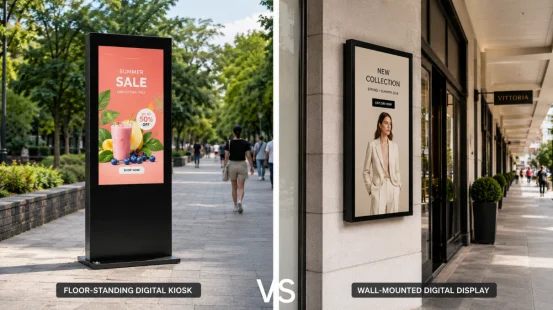
This format works best where the screen needs to join the pedestrian journey instead of becoming part of a wall. Product documentation lists public squares, streets, parks, communities, scenic areas, and other high-traffic outdoor spaces as typical uses.
At a mall entrance, an outdoor digital signage display can show promotions before visitors enter. In a plaza, it can mix advertising with public notices. At a transport hub, an outdoor digital signage kiosk can support guidance or touch inquiry. Industrial parks and corporate campuses also use outdoor LCD digital signage for directions, safety notices, and visitor information.
Hardware is only part of the project. A supplier should be able to match cabinet protection, brightness, operating temperature, software, networking, and installation details to the site, then test the finished unit before shipment.
RSXD develops wall-mounted, floor-standing, and outdoor commercial display equipment. Its documented capabilities include customization of size, protection level, enclosure, hardware, software, and remote management. Outdoor and high-brightness models receive high- and low-temperature, waterproof, dustproof, and shock-resistance tests.
Finished products also undergo at least 48 hours of high-temperature aging in the documented production process. Remote device management, scheduled content publishing, touch options, and project-specific networking are available for suitable configurations. These points matter when you compare an outdoor freestanding display with a fixed wall solution, because the right choice can change from one site to the next. More product and service information is available on the RSXD website.
Q1: Is outdoor freestanding digital signage suitable for permanent installation?
A: Yes. Permanent units should use suitable ground anchoring, protected power connections, and a cabinet rated for the local outdoor environment.
Q2: Is IP65 outdoor digital signage waterproof?
A: IP65 protects against dust and water jets, which suits many outdoor sites. Cable entries, drainage, installation quality, and local weather still matter.
Q3: Can a freestanding digital kiosk support touch?
A: Yes. Touch options are available on some configurations for wayfinding, inquiry, and self-service.
Q4: Is freestanding vs wall mounted digital signage strictly a cost choice?
A: No. Space and sightlines are critical. Interaction and structural conditions matter deeply. Furthermore, weather elements and maintenance access outweigh the initial hardware price.
Q5: When to pick an outdoor freestanding display over wall mounting?
A: Select it if prime viewing spots lack usable walls. Choose it when foot traffic demands standalone placement. Touch access justifies this setup. Lastly, future site changes make fixed positioning problematic.