Rongsheng Xingda Technology Co., Ltd.: Signed a cooperation agreement with Hubei Jinjiadun Passenger Station for 1,000 19-inch wall-mounted advertising machines.
Hubei Jinjiadun Station Management Branch, affiliated with Hubei Highway Passenger Transport Group Co., Ltd., is located adjacent to Hankou Railway Station and Wuhan Tianhe Airport. It is a national AAA-level passenger transport hub and has passed ISO9001:2000 international quality management system certification. The station operates over 1,000 daily departures, carrying over 30,000 passengers. Its routes cover most provinces across the country. With an investment of over 25 million yuan in luxury renovations, it is one of the most luxurious high-speed passenger stations in Central and Southern China. The station boasts comprehensive service functions: it includes air and rail ticketing, e-commerce services, a freight express center, a tourist reception center, a large supermarket, an auto repair shop, a gas station, a hotel, and a guesthouse, providing convenient transportation, dining, accommodation, entertainment, and shopping for passengers.
The station’s advantageous geographical location and convenient transportation network give it a unique regional advantage. The station is a national AAA-level passenger transport hub and has passed ISO9001:2000 international quality management system certification. It operates over 1,000 daily departures, carrying over 30,000 passengers. Its routes cover most provinces across the country. With an investment of over 25 million yuan in luxury renovations and upgrades, it is one of the most luxurious high-speed passenger stations in Central and Southern China. As a public, fully open passenger transport station, Jinjiadun Station comprehensively promotes corporate brand service innovation and establishes a service philosophy of integrity. Adhering to a market-oriented approach and focusing on passenger needs, it meticulously builds its corporate brand and has established the “Seven-Color Service Team,” a boutique team specializing in distinctive services. With the principles of “safety, comfort, and speed,” it starts by providing guided services to passengers and carries out various innovative services, truly allowing passengers to experience our commitment to “zero-distance communication and endless service,” thus establishing a new image of high-quality highway passenger transport service.
In recent years, in-vehicle advertising machines have increasingly come into our view, especially in places with high population mobility such as train stations, buses, and long-distance coaches, where advertising can play a particularly good role. Carefully examining the history of advertising machines reveals a long and intriguing history.
With increasing speed and improved facilities, our modes of transportation have become more comfortable. From rickshaws and motorbikes of the past to cars, high-speed trains, and regular trains today, it’s a history of both hardship and progress. Along with these changes, the facilities on board have also quietly evolved. In this commercialized era, some businessmen have discovered the potential business opportunity in in-vehicle entertainment machines. In the enclosed space of a vehicle, using mandatory viewership, they can effectively promote products. For advertising, in-vehicle entertainment machines have transformed into in-vehicle advertising machines, a new product that greatly assists advertising machine companies in promoting their products. From old-fashioned car radios and car stereos to today’s advertising machines, we can’t help but feel how rapidly society has progressed. Looking at this ever-changing society, we should also have greater enthusiasm for advertising machines, which will bring even more excitement to people.
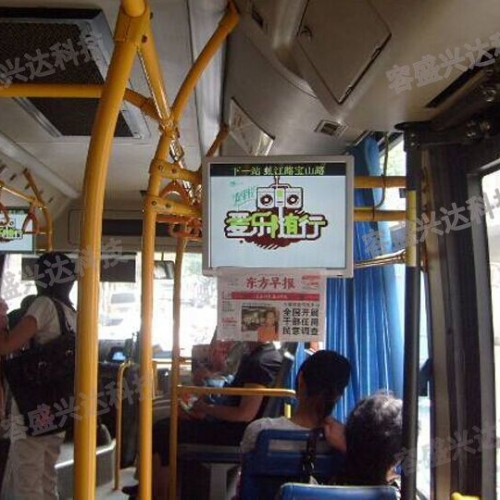
The Jinjiadun Bus Station in Hubei Province purchased 1000 in-vehicle advertising machines and 1000 GPS station announcement devices from our company. In-vehicle advertising machines are a service project primarily aimed at enriching in-vehicle entertainment and cultural life, supplemented by advertising. In-vehicle advertising provides a new space with wide coverage and high frequency of consumer contact, integrating images and sound, fully utilizing the mobility and large passenger capacity of buses to fill the information gaps for passengers during their journey. In-vehicle television advertising is advertising you can’t avoid; it’s the only source of viewing for passengers. The single channel, the enclosed environment, and the relatively high broadcast frequency reinforce memory. High-frequency broadcasts and repeated memorization result in outstanding advertising effects. High-quality stereo sound and video playback, interspersed with entertainment programs and advertisements, with commercials every 10 minutes in a loop, create a powerful audio-visual experience. Passengers can easily absorb the advertisements while enjoying the programs, leaving a lasting impression and achieving excellent promotional results for businesses and products.
The lowest advertising investment cost, rapid dissemination, and quick achievement of household name awareness. Advertising fees are relatively low compared to other media, yet have the greatest impact. Various formats and price points are available for flexible selection. Main formats: video ads, subtitle ads, corner ads, image ads, etc. Playback types: movie, music, photo; Playback modes: random playback, full repeat playback, single track repeat playback, sequential playback, automatic playback upon startup. Interstitial Advertising: Supports scheduled advertising, divided into 4 time slots per day, each slot can accommodate different advertisements, and multiple advertisements can be inserted at once per session. The number of insertions can be recorded. Customers may find the journey boring; installing an advertising machine not only promotes the company but also allows passengers to watch movies offered by the company. It can also attract external advertisers. Compared to other outdoor media, in-vehicle television advertising appears in people’s field of vision more proactively. Its dissemination method is the most aggressive and compelling. From the perspective of attention, during a boring journey, the only place where the eye can and should linger is a vibrant television commercial in the confined space of a vehicle. From a psychological perspective, people are fully focused on the program, making it easier for your advertisement to achieve better results. This kind of advertising has a compelling force, compelling people to subconsciously accept the advertising content and deeply embed it in their minds.
By directly engaging with consumers and forcibly conveying advertising messages, the effectiveness of advertising is fundamentally enhanced, achieving a receptiveness rate of over 90%, something other media advertising cannot achieve. In the monotonous environment of a moving vehicle, such television advertising provides relaxation, avoiding the irritability often associated with traditional television commercials. This ensures high actual reach. The moving nature of the vehicle also increases pedestrian traffic, expanding the reach of your advertising. In-vehicle television advertising is suitable for almost all industries. Furthermore, companies that previously only advertised with major brands are rapidly changing their views on in-vehicle television advertising, gaining a market advantage. It can be said that in-vehicle television advertising has permeated various industries and naturally integrated into all aspects of people’s daily lives. In-vehicle television advertising offers the greatest visibility among outdoor advertising media. The average operating distance of a bus is approximately 13 km, with an average coverage area of 0.3 square kilometers per bus. It operates an average of 10 times per day, reaching over 87,000 people daily. Based on a 3-month advertising period, the effective OTS (Original Time To See) can reach 7,800,000 people.
The mobility of the bus allows businesses to target their advertising messages near specific locations, achieving their advertising goals. Simultaneously, the crisscrossing network of bus media covers all areas of the city, providing broad advertising reach and effectively reaching the target audience. According to statistics from Quark Market Research, among mainstream media nationwide, magazines have the highest average cost per thousand impressions (CPM) at 20.8 yuan, followed by television advertising at 20.64 yuan, newspaper advertising at 10.28 yuan, and radio advertising at 4.43 yuan. Bus television advertising is below this budget. Therefore, among all media, bus television advertising has the lowest average CPM and is the most competitive.
Regarding lifestyle attitudes, 65% of consumers prefer products containing natural ingredients, 52% consider advertising indispensable in life, and 53% enjoy personalized pursuits. However, when commercials interrupt television viewing, 68% of consumers change the channel, resulting in a significant waste of advertisers’ budgets – half of your advertising budget is being wasted on channel-changing. Long-term in-vehicle TV advertising can achieve maximum advertising effectiveness in the shortest time, enhancing product awareness for the longest period at the lowest cost.